|
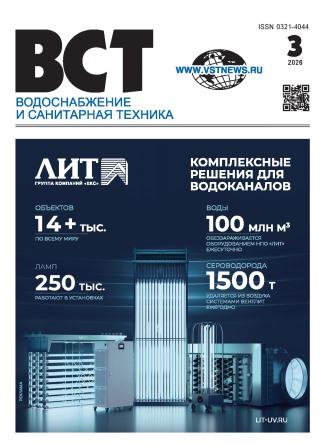
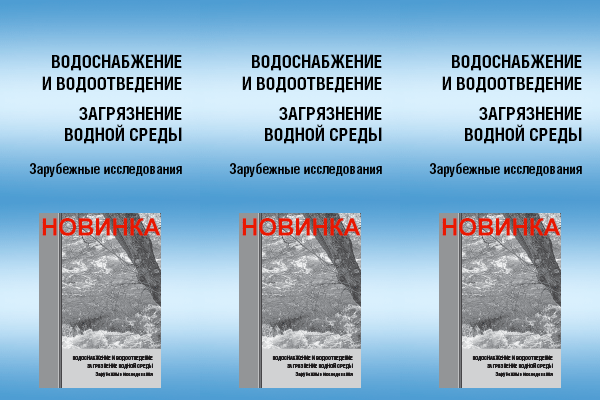
Number 3 / 2026
To download all number in format PDF (in Russian) The further text is accessible on a paid subscription.
For authorisation enter the login/password.
Or subscribe
Number maintenance (pdf) (doc)
Number abstract (doc)
Literature lists to articles (doc)
|
UDC 628.166
DOI 10.35776/VST.2026.03.01
Vil’k Mikhail, Rakhmanin Iurii, Strelkov Aleksandr, SHVETSOV V. N.
On the need for a radical modernization of water treatment facilities in the context of meeting the requirements of the sanitary and hygienic legislation
Summary
The need for a radical modernization of water treatment facilities in the Russian Federation in light of the tightening requirements of the sanitary and hygienic legislation is substantiated. An analysis of new standards (SanPiN 1.2.3685-21) is conducted, with special attention paid to the significant reduction in maximum permissible concentrations for a range of chemical (residual aluminum, total organic carbon, disinfection by-products of chlorination and ozonation) and microbiological indicators (including chlorine- and ozone-resistant cysts and oocysts of pathogenic protozoa and viruses). It is shown that the simultaneous achievement of both chemical and microbiological standards using existing traditional treatment schemes becomes practically impossible without revising the role of primary and secondary oxidation and introducing additional non-chemical stages of purification and disinfection. Multi-barrier technological schemes successfully implemented in major cities of Russia (Moscow, St. Petersburg, Cherepovets, Nizhny Novgorod) and worldwide (New York, Paris, Helsinki) are considered in depth. The key feature of these schemes is the effective combination and redistribution of roles between chemical (ozonation, chlorination) and physical (UV irradiation, membrane filtration, sorption) methods of purification and disinfection. This approach provides for minimizing the formation of toxic disinfection by-products, ensuring reliable removal of resistant microorganisms, and adapting systems to the variable quality of source water, especially for surface water sources. The conclusion is drawn that the step-by-step modernization of water treatment facilities with the introduction of multi-barrier technologies is not only a mandatory condition for meeting the new sanitary requirements but also a strategic direction for enhancing the environmental and epidemiological safety of drinking water supply under the conditions of anthropogenic impact and climate change.
Key words
ultra-violet irradiation , modernization , potable water quality , membrane technology , water treatment facilities , sanitary regulations and standards , multi-barrier disinfection , disinfection by-products
|
UDC 628:001.32
DOI 10.35776/VST.2026.03.02
Bazhenov Viktor, Orlov Evgenii, Govorova Zh. M., Pavlinova I. I.
Academician of the Russian Academy of Sciences S. V. Iakovlev: at the turn of the millennium – a key for the future
Summary
The personality of RAS Academician Sergei Vasilyevich Iakovlev as a foremost authority in the water industry who wielded major influence on the development of water supply and wastewater disposal systems in Russia is highlighted. His life journey was complicated and efficient, intersecting with numerous historical events. S. V. Iakovlev was not only a world-renowned scientist but also a patriot working hard for the benefit of his homeland throughout his life. He was bringing up complex issues in the field of water supply and wastewater disposal, and addressing them in collaboration with his colleagues and students. His works and achievements in the water industry remain important for study today. RAS Academician S.V. Iakovlev imparted the imperative to strictly adhere to the rules of solicitous attitude to water – an essential resource without which human life is impossible.
Key words
water supply , water disposal , water , NII VODGEO , S. V. Iakovlev , Moscow State University of Civil Engineering , scientific studies , patriotism
|
UDC 628.312.5:621.373.8
DOI 10.35776/VST.2026.03.03
Movchan Sergei
Monitoring the parameters of impurity particles in aqueous solutions in industrial wastewater treatment systems
Summary
One way to control wastewater quality is determining the parameters of impurity particles in recycling water supply systems with the help of laser Doppler interferometers. Photodetectors of laser Doppler interferometry optical systems use prismatic quantum dots for contactless measurement of impurity particle parameters in wastewater from local treatment facilities to monitor the quality of industrial wastewater treatment. Simulation of prismatic hexagonal rectangular quantum dots with a shell, their energy spectrum, and its dependence on the quantum dot parameters are considered. Possible using a quantum dot-based receiver in water treatment quality control systems is also analyzed. An optical system for express-monitoring of impurity parameters in wastewater has been developed. Mathematical computer simulation of the numerical solution of the Schrödinger equation for the S-state of the wave function and the determination of energy eigenvalues, as well as boundary conditions for the core-shell system, was used. The wave function and energy eigenvalues for prismatic hexagonal quantum dots were obtained, and the possibility of their use in photodetectors of optical laser interferometry systems was considered. The experimental laser measuring setup contains a photodetector where prismatic quantum dots are used to provide for the receiver selectivity for the wavelength of a helium-neon laser and for increasing the accuracy and range of real-time measurements.
Key words
wastewater , water treatment , aqueous solution , impurity particles , particle parameters , Schrödinger equations , S-electrons , quantum dots , energy spectrum , photomultiplier
|
UDC 628.35
DOI 10.35776/VST.2026.03.04
Koulakov A. A.
Specifics of choosing technological solutions for small-scale wastewater treatment facilities
Summary
Small-scale wastewater treatment facilities have a number of features to be taken into consideration during design and operation. The process solutions for mechanical and biological wastewater treatment, as well as tertiary treatment and sludge processing are considered. Examples of facility calculations are provided outlining significant differences in the required layout and capacity of aeration tanks for different input loads. A biological treatment unit design with flexible control for variable input mass loads is proposed. A high probability of the need for dosing an external substrate source for denitrification is noted. Recommendations are provided for the design of small-scale treatment facilities of various capacities emphasizing that the operating depth of aeration tanks and secondary settlers is an important factor. Shallow depths (less than 2–2.5 m) increase the risk of biomass carryover and process disruption. In general, while selecting solutions for small-scale facilities, a combination of technological and economic criteria should be considered to ensure the facility is efficient enough with adequate capital and operating costs.
Key words
nitrification , denitrification , domestic wastewater , sewerage treatment facilities , small-scale structures , process volumes , substrate
|
UDC 628.355:615.281.8
DOI 10.35776/VST.2026.03.05
Pukemo M. M., Kadyseva Anastasiia
The impact of antivirals in wastewater of the healthcare institutions on the performance of wastewater treatment facilities
Summary
The problem of pharmaceutical contamination with antivirals of wastewater of healthcare institutions and the negative impact on the performance of wastewater treatment facilities is considered. Special attention is paid to the main groups of antivirals, that is, neuraminidase inhibitors (oseltamivir, zanamivir), nucleoside analogues (acyclovir, ribavirin), and antiretroviral agents (lamivudine, ritonavir, nevirapine), that are characterized by high biological activity, biodegradation resistance, and are difficult to remove by traditional methods (7–32%). The results of studying the impact of various groups of antivirals on nitrification, denitrification, and organics removal are presented. A comparative analysis of the effectiveness of activated sludge and attached biocenosis systems is provided. Kinetic constants of inhibition for the key biological treatment processes are presented. Technological solutions for improving the efficiency of removing antivirals from wastewater of healthcare institutions are proposed. The results are of considerable practical importance for optimizing wastewater treatment and minimizing environmental risks.
Key words
wastewater , biological treatment , nitrification , denitrification , antivirals , healthcare institutions , pharmaceutical micropollutants
|
UDC 628.147:006.3
DOI 10.35776/VST.2026.03.06
Primin Oleg, Minchenkov Aleksandr, Khaliapin Aleksandr
Efficiency of laying pipes made of ductile iron in seismically hazardous areas
Summary
At the current stage of housing and utilities reformation, with increasingly stringent requirements for the reliability and durability of municipal utility pipelines, the need to develop requirements for the selection of pipe materials and types tailored to the specific conditions of the installation and operation of urban water supply systems is becoming increasingly important. Proper selection of pipe materials is crucial to provide for the reliability of water pipelines in earthquake-prone areas of Russia. It is demonstrated that ductile iron pipes are currently the most promising choice for use in drinking water supply systems in earthquake-prone areas. It is noted that ductile iron possesses high strength properties similar to those of low-carbon steel (ultimate tensile strength, yield strength, and percentage elongation) and improved corrosion resistance. Information on seismic resistance calculations for ductile iron pipelines is provided to verify their safety for use in earthquake-prone areas.
Key words
water supply , reliability , ductile iron , calculation , materials , pipes , earthquake-prone areas
|
UDC 628.147
DOI 10.35776/VST.2026.03.07
Volosukhin Viktor, Prodous O. A., Iakubchik P., Shipilov A. A.
Hydraulic safety of operating obsolete utility networks with internal deposits
(for discussion)
Summary
As a result of the conducted research, a quantitative criterion was developed for estimating the hydraulic safety of obsolete utility networks with internal deposits on the pipe walls. It is proposed to quantitatively estimate the hydraulic safety of obsolete utility networks by their operational efficiency coefficient minus 1%. A specific example demonstrates the method for calculating the hydraulic safety coefficient for an obsolete steel water pipeline with internal deposits.
Key words
metal utility networks , hydraulic pipe characteristics , operational efficiency coefficient , hydraulic safety
|
|