|
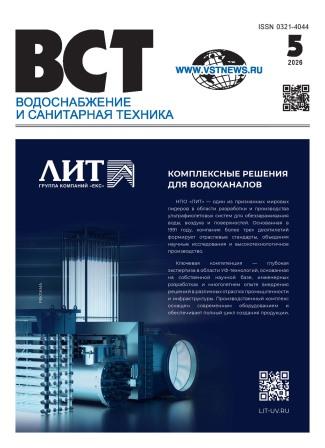
Number 5 / 2026
To download all number in format PDF (in Russian)The further text is accessible on a paid subscription.
For authorisation enter the login/password.
Or subscribe
Number maintenance (pdf) (doc)
Number abstract (doc)
Literature lists to articles (doc)
|
UDC 628.16.081
DOI 10.35776/VST.2026.05.01
Seliukov Aleksandr
Process engineering solutions for the purification
of low-mineralized cold groundwater with chemicals
Summary
The paper completes a series of studies on the purification of low-mineralized cold groundwater, often used for drinking water supply in the Russian regions in permafrost zones. The update of the earlier developed process solutions and expansion of their scope of application are reported. A full description of the chemical processes occurring during water treatment with chemicals including hydrogen peroxide, potassium permanganate, and caustic soda is provided. The proposed process solutions provide for drinking water meeting the regulatory quality standards for organoleptic indicators, iron, manganese, hydrogen sulfide, phenols, and oil products. At the same time the consistency of the water after purification is guaranteed which allows to prevent from the secondary pollution in water mains and distribution networks. Two basic process flow schemes of the water conditioning process are presented that differ in their scope of application depending on the quantitative composition of groundwater. Water quality indicators after purification are presented based on the results obtained during the pilot tests at various sites. It is noted that the developed process solutions provide for upgrading outdated groundwater de-ironing facilities at minimal cost, whereby the standard quality of the water is provided.
Key words
potassium permanganate , cold low-mineralized ground water , stabilization treatment , caustic soda , treatment process flow schemes , hydrogen peroxide , iron, manganese, hydrogen sulfide removal
|
UDC 556.18:626/62
DOI 10.35776/VST.2026.05.02
Nikolenko Il’ia, Mel’nikova Natal’ia
Concepts and methods of estimating the sustainability of water supply systems
Summary
Concepts and methods for estimating the sustainability of water supply systems, covering technical, technological, environmental, and social aspects are analyzed. The importance of the sustainability of complicated water supply systems for the sustainable development of regions and cities, as well as their role in providing for the life support, comfortable living conditions, economic growth, and technogenic safety is emphasized. A comprehensive approach to estimating the sustainability of water supply systems is proposed, encompassing an analysis of the parameters at four levels. This approach provides for an objective and overall estimate of the system status and development of effective measures to improve their sustainability. The focus is on the methods for monitoring, predicting potential failures, and adapting water supply systems to the changing external conditions.
Ключевые слова
sustainability and reliability of water supply systems , sustainability criteria, concepts, estimation methods, parameters
|
UDC 628.112.24:628.161.3
DOI 10.35776/VST.2026.05.03
Rastorguev Ivan
Model of well clogging during in situ groundwater deironing
Summary
The study focused on the evolution of aquifer porosity during operation of in situ groundwater treatment systems at a water intake facility in the Russian Far East. The objective was to evaluate precipitate distribution and changes in aquifer hydraulic conductivity within the near-wellbore zone. Predictive simulations of precipitate accumulation were performed. The resulting additional drawdown, as well as reductions in permeability and porosity of the near-filter formation, were assessed. The precipitation zone develops directly adjacent to the well at the injected oxygen concentration of 12.5 mg/l. Simulations show that precipitate accumulation near the well caused an additional drawdown of approximately 5 m and reduced the specific capacity of the well. Coupled groundwater flow and geochemical models of well clogging were developed. The models account for variable permeability and porosity controlled by the volume of deposited iron oxides.
Key words
filter , iron , permeability , well , porosity , filtration of coefficient , injection , pumping , precipitate accumulation , oxidation kinetics , oxygen
|
UDC 551.583:628.29
DOI 10.35776/VST.2026.05.04
Gasho Evgenii, Porunov Dmitrii
Storm rainfall management in the context of changing climate risks: international practices and recommendations for Moscow
Summary
The aspects of the adaptation of the municipal storm sewer infrastructure in Moscow to the changing climate risks are considered. Based on the analysis of the precipitation data for the period 1990–2024 (weather station No. 27612, VDNKh, Moscow), it is shown that while the annual total amount is close to the climatic norm, short-term extreme peaks intensify and the seasonal structure changes. The strategies adopted in Tokio, Stockholm and Beijing are considered: the best results are demonstrated by the multi-level architecture integrated with the proper operation and information systems. The limitations of the examined cases are also shown: the nonuniform preparedness of Beijing districts and their vulnerability to extreme precipitation events are confirmed. In Stockholm the actual failure of the policy based primarily on «green» stormwater management infrastructure is recorded. For the Moscow conditions, limited use of infiltration solutions and a focus on storage with apportioned discharge of stormwater into the network are recommended. Some measures are identified that are incapable of ensuring the required level of protection against flooding, and not recommended for being used in the city. A multistaged plan is proposed, i. e. fast-response measures to address flooding at critical points; long-term measures to upgrade and adapt the existing system. The role of communication with residents and maintenance procedures is emphasized as a prerequisite for the sustainability of the measures taken.
Key words
stormwater infrastructure , extreme showers , grey infrastructure , blue-green infrastructure , city stormwater management policies
|
UDC 628.169.2
DOI 10.35776/VST.2026.05.05
Belousov Aleksandr
Domestic decanters for wastewater sludge thickening and dewatering
Summary
The issues of import phase-out and technical re-equipping in the development and production of decanters designed for wastewater sludge dewatering and thickening are addressed in the paper. Technical specifications for the equipment and information on the companies rendering high-quality decanter repair services are set. The development trends and challenges the Russian dewatering equipment manufacturers are facing are specified. This review article is intended to render practical assistance to the environmental engineers, production workers, and facility managers in using decanters at the water and wastewater treatment facilities.
Key words
dehydration , capacity , sludge , decanter , rehabilitation , thickening , import substitution
|
UDC 628.147.22
DOI 10.35776/VST.2026.05.06
Prirez Denis, Prorekhin Sergei, Tusheva Mariia, Butakova Mariia
Chemical treatment of heat transfer medium to prevent corrosion under conditions of the zinc coating polarity reversal in hot water supply systems
Summary
While operating galvanized main pipelines in hot water supply systems, problems associated with accelerated pipe corrosion arise. Under normal operating conditions, the zinc coating is anodic and provides for both mechanical and electrochemical steel protection. Zinc coating damage or presence of pores in it do not cause steel corrosion, but rather expedite destruction of the coating itself. Changing environmental conditions can cause a polarity shift in the zinc coating resulting in the increased steel dissipation in pores, cracks, and scratches. Possible using chemical treatment of the heat transfer agent to prevent corrosion under conditions of polarity shifts in the zinc coating of pipes is discussed.
Key words
reagent treatment , water treatment , hot water supply system , zinc coatings , scale inhibitor , corrosion rate , zinc plated steel
|
UDC 697.13
DOI 10.35776/VST.2026.05.07
Gataullina Alina, Gazyev Il’shat, Райзер Ю. С.
The effect of heat-conducting inclusions on the heat absorption of enclosing structures
Summary
The presence of various high-heat conducting inclusions in external enclosing structures leads to a thermal resistance decrease and heat loss increase resulting in the overspend of primary energy resources. Currently, the issues of heat-conducting inclusion accounting and their effect on heat loss is relevant, since linear inhomogeneities account for up to 40% of losses, whereas point inhomogeneities account for up to 25%. The object of the study is determining the effect of high-heat conducting inclusions in the calculation of external enclosing structures with account of the heat absorption of the materials used. A literature review was conducted to identify the issues related to the heat loss through enclosing structures containing high-heat conducting inclusions. Heat loss through a multilayer enclosing structure containing a high-heat conducting inclusion was simulated, and a comparative analysis of the effect of the high-heat conducting inclusion was presented with account of the material heat absorption. The study focused on heterogeneous exterior walls of buildings constructed from precast elements containing high-heat conducting inclusions. The research subject is the thermal state of an enclosing structure and patterns of temperature fields and heat flows in heterogeneous exterior walls of buildings constructed from precast elements with high-heat conducting inclusions. The research method involves computer modeling of physical processes within the enclosing structure under specified boundary conditions.
Key words
heat losses , heterogeneous inclusions , thermal resistance , heat-conducting elements , material heat absorption
|
|